
Chevrolet Spark Owners Manual: Heated Front Seats
Warning
If you cannot feel temperature change or pain to the skin, the seat heater may cause burns. To reduce the risk of burns, people with such a condition should use care when using the seat heater, especially for long periods of time. Do not place anything on the seat that insulates against heat, such as a blanket, cushion, cover, or similar item. This may cause the seat heater to overheat. An overheated seat heater may cause a burn or may damage the seat.
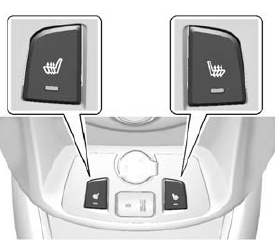
If available, the buttons are below the climate control system. To operate, the engine must be running.
Press  or
or
 to heat the driver or passenger seat.
The indicator light on the control turns on when this feature is on. Press the control
again to turn this feature off.
The passenger seat may take longer to heat up.
 Front Seat Armrest
There is an armrest on the inboard side of the driver seat. To raise or lower
the armrest, push up or pull down on the armrest. ...
 Rear Seats
Folding the Seatback
Either side of the seatback can be folded down for more cargo space.
Fold a seatback only when the vehicle is not moving.
Caution
Folding a rear seat with the safety belts sti ...
Other materials:
Hill Start Assist (HSA)
This vehicle has an HSA feature, which may be useful when the vehicle is stopped
on a grade sufficient enough to activate HSA.
This feature is designed to prevent the vehicle from rolling, either forward
or rearward, during vehicle drive off. After the driver completely stops and holds
the ve ...
Connections
The required specific Onstar subscription plan includes the services that follow
to help customers stay connected.
For coverage maps, see www.onstar.com (U.S.) or www.onstar.ca (Canada).
WiFi Connectivity (If Equipped)
The vehicle has a WiFi hotspot that provides a high-speed, wireless Internet ...
Information Displays
Driver Information Center (DIC)
The DIC displays information about the vehicle. It also displays warning messages
if a system problem is detected. See Vehicle Messages on page 5-26. All messages
appear in the DIC display in the instrument cluster.
DIC Operation and Displays
The DIC has differ ...
