
Chevrolet Spark Owners Manual: Top Tether Anchor
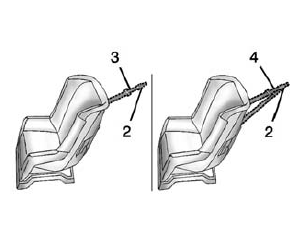
A top tether (3, 4) anchors the top of the child restraint to the vehicle.
A top tether anchor is built into the vehicle. The top tether attachment (2) on the child restraint connects to the top tether anchor in the vehicle in order to reduce the forward movement and rotation of the child restraint during driving or in a crash.
The child restraint may have a single tether (3) or a dual tether (4).
Either will have a single attachment (2) to secure the top tether to the anchor.
Some child restraints that have a top tether are designed for use with or without the top tether being attached. Others require the top tether always to be attached. In Canada, the law requires that forward-facing child restraints have a top tether, and that the tether be attached. Be sure to read and follow the instructions for your child restraint.
 Lower Anchors
Lower anchors (1) are metal bars built into the vehicle. There are two lower
anchors for each LATCH seating position that will accommodate a child restraint
with lower attachments (2). ...
 Lower Anchor and Top Tether Anchor Locations
(Top Tether Anchor): Seating positions
with top tether anchors.
(Lower Anchor): Seating positions
with two lower anchors.
To assist in locating the lower
anchors, each seating position w ...
Other materials:
Turn and Lane-Change Signals
Move the lever all the way up or down to signal a turn.
An arrow on the instrument cluster flashes in the direction of the turn or lane
change.
Raise or lower the lever until the arrow starts to flash to signal a lane change.
Hold it there until the lane change is completed.
If the lever ...
Using the USB Port
The infotainment system can play music or movies by connecting an auxiliary device
to the USB port.
USB Support
If equipped, the USB connector is in the center stack, and uses the USB 2.0 standard.
USB Supported Devices
USB Flash Drives
Portable USB Hard Drives
2G–5G iPod nano®
1G–3G ...
Braking
Braking action involves perception time and reaction time. Deciding to push the
brake pedal is perception time. Actually doing it is reaction time.
Average driver reaction time is about three-quarters of a second. In that time,
a vehicle moving at 100 km/h (60 mph) travels 20m (66 ft), which co ...
