
Chevrolet Spark Owners Manual: Reclining Seatbacks
Warning
If either seatback is not locked, it could move forward in a sudden stop or crash. That could cause injury to the person sitting there.
Always push and pull on the seatbacks to be sure they are locked.
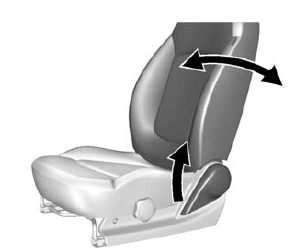
To recline the seatback:
- Lift the lever.
- Move the seatback to the desired position, and then release the lever to lock the seatback in place.
- Push and pull on the seatback to make sure it is locked in place.
To return the seatback to the upright position:
- Lift the lever fully without applying pressure to the seatback, and the seatback will return to the upright position.
- Push and pull on the seatback to make sure it is locked.
Warning
Sitting in a reclined position when the vehicle is in motion can be dangerous. Even when buckled up, the safety belts cannot do their job.
The shoulder belt will not be against your body. Instead, it will be in front of you. In a crash, you could go into it, receiving neck or other injuries.
The lap belt could go up over your abdomen. The belt forces would be there, not at your pelvic bones. This could cause serious internal injuries.
For proper protection when the vehicle is in motion, have the seatback upright. Then sit well back in the seat and wear the safety belt properly.
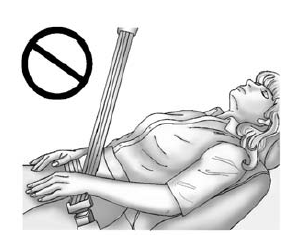
Do not have a seatback reclined if the vehicle is moving.
 Seat Adjustment
Manual Seats
Warning
You can lose control of the vehicle if you try to adjust a driver
seat while the vehicle is moving.
Adjust the driver seat only when the vehicle is not moving.
To adjust ...
 Front Seat Armrest
There is an armrest on the inboard side of the driver seat. To raise or lower
the armrest, push up or pull down on the armrest. ...
Other materials:
Lap-Shoulder Belt
All seating positions in the vehicle have a lap-shoulder belt.
The following instructions explain how to wear a lap-shoulder belt properly.
Adjust the seat, if the seat is adjustable, so you can sit up straight.
To see how, see “Seats” in the Index.
Pick up the latch plate and pull ...
Fuel
Use of the recommended fuel is an important part of the proper maintenance of
this vehicle. When driving in the U.S. and Canada, to help keep the engine clean
and maintain optimum vehicle performance, we recommend using TOP TIER Detergent
Gasolines.
See www.toptiergas.com for a list of TOP TI ...
Steering Wheel Controls
If equipped with audio steering wheel controls, some audio controls can be adjusted
at the steering wheel.
SEEK or SEEK
(Next/ Previous): Press to go to the
next or previous radio station, song on an iPod®, or file on a USB device (if equipped).
(Push to Talk): If equipped with
Bluet ...
