
Chevrolet Spark Owners Manual: Doors
Liftgate
Warning
Exhaust gases can enter the vehicle if it is driven with the liftgate, hatch/trunk open, or with any objects that pass through the seal between the body and the hatch/trunk or liftgate. Engine exhaust contains carbon monoxide (CO) which cannot be seen or smelled. It can cause unconsciousness and even death.
If the vehicle must be driven with the liftgate or hatch/trunk open:
- Close all of the windows.
- Fully open the air outlets on or under the instrument panel.
- Adjust the climate control system to a setting that brings in only outside air and set the fan speed to the highest setting. See “Climate Control Systems” in the Index.
- If the vehicle is equipped with a power liftgate, disable the power liftgate function.
For more information about carbon monoxide, see Engine Exhaust on page 9-20.
Caution
To avoid damage to the liftgate or liftgate glass, make sure the area above and behind the liftgate is clear before opening it.
To lock or unlock the liftgate from the outside, use the key in the liftgate lock.
If equipped, press  on the RKE transmitter
to unlock all doors and press  to lock.
See Remote Keyless Entry (RKE) System Operation on page 2-3.
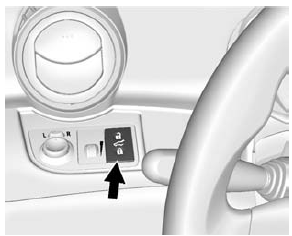
Without RKE
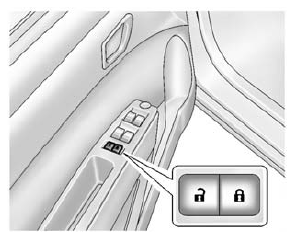
With RKE
To lock or unlock the liftgate from the inside, press
or
.
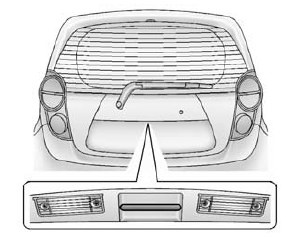
To open the liftgate, pull the handle and lift up.
When closing the liftgate, use the pull cup.
See Central Locking System on page 2-6.
 Safety Locks
The vehicle has rear door safety locks on each rear door that prevent passengers
from opening the rear doors from the inside.
Using the Rear Door Safety Lock
Move the lever up to lock.
Cl ...
 Vehicle Security
This vehicle has theft-deterrent features; however, they do not make the vehicle
impossible to steal. ...
Other materials:
Radio with Touchscreen
VOL
(Volume)
Press to decrease or increase the volume.
(Power)
Press and hold to turn the power on or off.
(Home Page)
Press to go to the Home Page. See Home Page (Radio with Touchscreen) on
page 7-5.
...
Vehicle Data Recording and Privacy
The vehicle has a number of computers that record information about the vehicle’s
performance and how it is driven. For example, the vehicle uses computer modules
to monitor and control engine and transmission performance, to monitor the conditions
for airbag deployment and deploy them in a cr ...
Towing the Vehicle
Caution
Incorrectly towing a disabled vehicle may cause damage. The damage
would not be covered by the vehicle warranty.
Have the vehicle towed on a flatbed car carrier or a wheel lift tow truck.
If a wheel lift tow truck is used, the drive wheels cannot contact the road while
the vehicle is ...
