
Chevrolet Spark Owners Manual: Securing Child Restraints (Rear Seat)
When securing a child restraint in a rear seating position, study the instructions that came with the child restraint to make sure it is compatible with this vehicle.
If the child restraint has the LATCH system, see Lower Anchors and Tethers for Children (LATCH System) on page 3-40 for how and where to install the child restraint using LATCH. If a child restraint is secured in the vehicle using a safety belt and it uses a top tether, see Lower Anchors and Tethers for Children (LATCH System) on page 3-40 for top tether anchor locations.
Do not secure a child seat in a position without a top tether anchor if a national or local law requires that the top tether be anchored, or if the instructions that come with the child restraint say that the top strap must be anchored.
In Canada, the law requires that forward-facing child restraints have a top tether, and that the tether be attached.
If the child restraint or vehicle seat position does not have the LATCH system, you will be using the safety belt to secure the child restraint in this position. Be sure to follow the instructions that came with the child restraint. Secure the child in the child restraint when and as the instructions say.
If more than one child restraint needs to be installed in the rear seat, be sure to read Where to Put the Restraint on page 3-38.
- Put the child restraint on the seat.
If the head restraint interferes with the proper installation of the child restraint, the head restraint may be removed. See “Head Restraint Removal and Reinstallation” under Lower Anchors and Tethers for Children (LATCH System) on page 3-40.
When installing a rear-facing child restraint, it may be necessary to move the front seat forward to properly install the child restraint per the child restraint manufacturer instructions. See Seat Adjustment on page 3-5.
- Pick up the latch plate, and run the lap and shoulder portions of the vehicle safety belt through or around the restraint. The child restraint instructions will show you how.
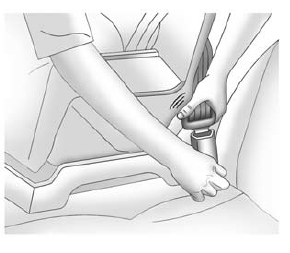
- Push the latch plate into the buckle until it clicks.
Position the release button on the buckle so that the safety belt could be quickly unbuckled if necessary.
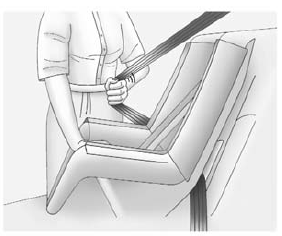
- Pull the shoulder belt all the way out of the retractor to set the lock. When the retractor lock is set, the belt can be tightened but not pulled out of the retractor.
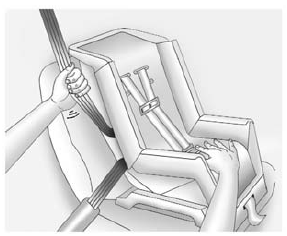
- To tighten the belt, push down on the child restraint, pull the shoulder
portion of the belt to tighten the lap portion of the belt, and feed the shoulder
belt back into the retractor. When installing a forward-facing child restraint,
it may be helpful to use your knee to push down on the child restraint as you
tighten the belt.
Try to pull the belt out of the retractor to make sure the retractor is locked. If the retractor is not locked, repeat Steps 4 and 5.
- If the child restraint has a top tether, follow the child restraint manufacturer's instructions regarding the use of the top tether. See Lower Anchors and Tethers for Children (LATCH System) on page 3-40 for more information.
- Before placing a child in the child restraint, make sure it is securely held in place. To check, grasp the child restraint at the safety belt path and attempt to move it side to side and back and forth. When the child restraint is properly installed, there should be no more than 2.5 cm (1 in) of movement.
To remove the child restraint, unbuckle the vehicle safety belt and let it return to the stowed position.
If the top tether is attached to a top tether anchor, disconnect it. If the head restraint was removed, reinstall it before the seating position is used. See “Head Restraint Removal and Reinstallation” under Lower Anchors and Tethers for Children (LATCH System) on page 3-40.
 Replacing LATCH System Parts After a Crash
Warning
A crash can damage the LATCH system in the vehicle. A damaged
LATCH system may not properly secure the child restraint, resulting in serious injury
or even death in a crash. To help make ...
 Securing Child Restraints (Front Passenger Seat)
This vehicle has airbags. A rear seat is a safer place to secure a forward-facing
child restraint. See Where to Put the Restraint on page 3-38.
In addition, the vehicle has a passenger sensing syst ...
Other materials:
Online Owner Center
Online Owner Experience (U.S.) my.chevrolet.com
The Chevrolet online owner experience allows interaction with Chevrolet and keeps
important vehicle-specific information in one place.
Membership Benefits
(Vehicle Information): Download
owner manuals and view vehicle-specific how-to videos.
...
Taillamps, Turn Signal, Stoplamps, and Back-Up Lamps
Stoplamp/Taillamp
Turn Signal Lamp/Taillamp
Back-up Lamp
To replace a taillamp, turn signal lamp, stoplamp, or back-up bulb:
Open the liftgate. See Liftgate on page 2-8.
Remove the two screws and the lamp assembly.
Turn the bulb socket counterclockwise and remove the so ...
Engine Compartment Overview
Windshield Washer Fluid Reservoir. See Washer Fluid on page 10-19.
Engine Coolant Surge Tank and Pressure Cap. See Cooling System on page 10-13.
Engine Oil Dipstick. See Engine Oil on page 10-8.
Engine Oil Fill Cap. See Engine Oil on page 10-8.
Engine Cooling Fan (Out of View). See Co ...
