
Chevrolet Spark Owners Manual: Instrument Panel
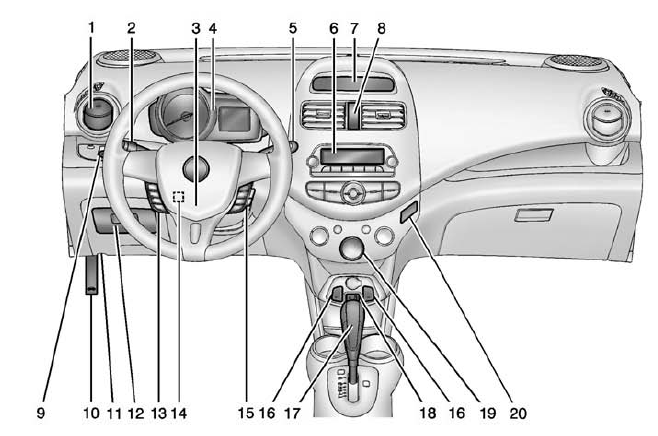
- Air Vents on page 8-3.
- Exterior Lamp Controls on page 6-1.
- Horn on page 5-2.
- Instrument Cluster on page 5-8.
- Windshield Wiper/Washer on page 5-3.
- Infotainment on page 7-1.
- Information Display.
- Hazard Warning Flashers on page 6-3.
- Instrument Panel Illumination Control on page 6-5. Power Mirrors on page 2-13 (If Equipped).
- Hood Release. See Hood on page 10-5.
- Data Link Connector (DLC) (Out of View). See Malfunction Indicator Lamp on page 5-12.
- Instrument Panel Fuse Block on page 10-34.
- Cruise Control on page 9-30 (If Equipped).
- Steering Wheel Adjustment on page 5-2.
- Steering Wheel Controls on page 5-2 (If Equipped).
- Heated Front Seats on page 3-7 (If Equipped).
- Shift Lever. See Automatic Transmission on page 9-21 (If Equipped) or Manual Transmission on page 9-23 (If Equipped).
- USB Port on page 7-16 (If Equipped).
- Climate Control Systems on page 8-1.
- Traction Control/Electronic Stability Control on page 9-27.
 In Brief
...
 Initial Drive Information
This section provides a brief overview about some of the important features that
may or may not be on your specific vehicle.
For more detailed information, refer to each of the features which can b ...
Other materials:
Hazard Warning Flashers
The hazard warning flasher button is on the center stack.
(Hazard Warning Flasher): Press
to make the front and rear turn signal lamps flash on and off.
This warns others that you are having trouble. Press the button again to turn
the flashers off.
When the hazard warning flashers are on, ...
Hydraulic Clutch
For vehicles with a manual transmission, it is not necessary to regularly check
brake/clutch fluid unless there is a leak suspected.
Adding fluid will not correct a leak.
A fluid loss in this system could indicate a problem. Have the system inspected
and repaired.
When to Check and What to Us ...
Scheduling Service Appointments
When the vehicle requires warranty service, contact your dealer and request an
appointment. By scheduling a service appointment and advising the service consultant
of your transportation needs, your dealer can help minimize your inconvenience.
If the vehicle cannot be scheduled into the service ...
