
Chevrolet Spark Owners Manual: Heated Front Seats
Warning
If you cannot feel temperature change or pain to the skin, the seat heater may cause burns. To reduce the risk of burns, people with such a condition should use care when using the seat heater, especially for long periods of time. Do not place anything on the seat that insulates against heat, such as a blanket, cushion, cover, or similar item. This may cause the seat heater to overheat. An overheated seat heater may cause a burn or may damage the seat.
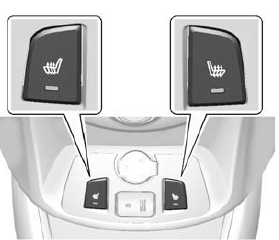
If available, the buttons are below the climate control system. To operate, the engine must be running.
Press  or
or
 to heat the driver or passenger seat.
The indicator light on the control turns on when this feature is on. Press the control
again to turn this feature off.
The passenger seat may take longer to heat up.
 Front Seat Armrest
There is an armrest on the inboard side of the driver seat. To raise or lower
the armrest, push up or pull down on the armrest. ...
 Rear Seats
Folding the Seatback
Either side of the seatback can be folded down for more cargo space.
Fold a seatback only when the vehicle is not moving.
Caution
Folding a rear seat with the safety belts sti ...
Other materials:
Torque Lock (Automatic Transmission)
If you are parking on a hill and you do not shift the transmission into P (Park)
properly, the weight of the vehicle may put too much force on the parking pawl in
the transmission. You may find it difficult to pull the shift lever out of P (Park).
This is called “torque lock.” To prevent torque ...
Windows
Warning
Never leave a child, a helpless adult, or a pet alone in a vehicle,
especially with the windows closed in warm or hot weather.
They can be overcome by the extreme heat and suffer permanent injuries or even
death from heat stroke.
The vehicle aerodynamics are designed to improve fu ...
Front Turn Signal/Parking Lamps
To replace a front turn signal bulb:
Open the hood. See Hood on page 10-5.
Turn the bulb socket counterclockwise and pull it out of the lamp housing.
Pull the bulb straight out of the bulb socket.
Install the new bulb into the socket by pressing it in.
Install the socket into the ...
