
Chevrolet Spark Owners Manual: How to Add Coolant to the Coolant Surge Tank
Caution
This vehicle has a specific coolant fill procedure. Failure to follow this procedure could cause the engine to overheat and be severely damaged.
If no problem is found, check to see if coolant is visible in the coolant surge tank. If coolant is visible but the coolant level is not at the indicated level mark, add a 50/ 50 mixture of clean, drinkable water and DEX-COOL coolant at the coolant surge tank, but be sure the cooling system, including the coolant surge tank pressure cap, is cool before you do it.
Warning
Steam and scalding liquids from a hot cooling system can blow out and burn you badly. Never turn the cap when the cooling system, including the surge tank pressure cap, is hot. Wait for the cooling system and surge tank pressure cap to cool.
Warning
Adding only plain water or some other liquid to the cooling system can be dangerous. Plain water and other liquids, can boil before the proper coolant mixture will.
The coolant warning system is set for the proper coolant mixture.
With plain water or the wrong mixture, the engine could get too hot but you would not get the overheat warning. The engine could catch fire and you or others could be burned. Use a 50/ 50 mixture of clean, drinkable water and DEX-COOL coolant.
Caution
In cold weather, water can freeze and crack the engine, radiator, heater core, and other parts. Use the recommended coolant and the proper coolant mixture.
Warning
You can be burned if you spill coolant on hot engine parts.
Coolant contains ethylene glycol and it will burn if the engine parts are hot enough. Do not spill coolant on a hot engine.
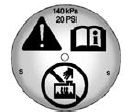 Remove the coolant surge tank
pressure cap when the cooling system, including the coolant surge tank pressure cap and upper radiator hose, is no longer hot.Turn the pressure cap slowly counterclockwise about one-quarter of a turn. If you hear a hiss, wait for that to stop. This will allow any pressure still left to be vented out the discharge hose.
- Keep turning the pressure cap slowly and remove it.
- Fill the coolant surge tank with the proper DEX-COOL coolant mixture to the indicated level mark.
- With the coolant surge tank pressure cap off, start the engine and let it
run until you can feel the upper radiator hose getting hot. Watch out for the
engine cooling fan.
By this time, the coolant level inside the coolant surge tank may be lower. If the level is lower, add more of the proper DEX-COOL coolant mixture to the coolant surge tank until the level reaches the indicated level mark.
- Reinstall the pressure cap tightly.
Caution
If the pressure cap is not tightly installed, coolant loss and possible engine damage may occur. Be sure the cap is properly and tightly secured.
Check the level in the coolant surge tank when the cooling system has cooled down. If the coolant is not at the proper level, repeat Steps 1–3 and reinstall the pressure cap. If the coolant still is not at the proper level when the system cools down again, see your dealer.
 Checking Coolant
The vehicle must be on a level surface when checking the coolant level.
It is normal to see coolant moving in the upper coolant hose return line when
the engine is running.
Check to see if coolant ...
 Engine Overheating
The vehicle has an indicator to warn of the engine overheating. See Engine Coolant
Temperature Warning Light on page 5-18.
If the decision is made not to lift the hood when this warning appears, ge ...
Other materials:
TPMS Malfunction Light
The TPMS will not function properly if one or more of the TPMS sensors are missing
or inoperable. When the system detects a malfunction, the low tire warning light
flashes for about one minute and then stays on for the remainder of the ignition
cycle. The malfunction light comes on at each ign ...
Child Restraint Systems
Rear-Facing Infant Seat
A rear-facing infant seat provides restraint with the seating surface against
the back of the infant.
The harness system holds the infant in place and, in a crash, acts to keep the
infant positioned in the restraint.
Forward-Facing Child Seat
A forward-facing ...
Tire Pressure Monitor System
The Tire Pressure Monitor System (TPMS) uses radio and sensor technology to check
tire pressure levels. The TPMS sensors monitor the air pressure in your tires and
transmit tire pressure readings to a receiver located in the vehicle.
Each tire, including the spare (if provided), should be check ...
