
Chevrolet Spark Owners Manual: Tire Rotation and Required Services Every 12 000 km/ 7,500 mi
Rotate the tires, if recommended for the vehicle, and perform the following services. See Tire Rotation on page 10-48.
- Check engine oil level and oil life percentage. If needed, change engine oil and filter, and reset oil life system. See Engine Oil on page 10-8 and Engine Oil Life System on page 10-10.
- Check engine coolant level. See Engine Coolant on page 10-14.
- Check windshield washer fluid level. See Washer Fluid on page 10-19.
- Visually inspect windshield wiper blades for wear, cracking, or contamination.
See Exterior Care on page 10-70. Replace worn or damaged wiper blades.
See Wiper Blade Replacement on page 10-24.
- Check tire inflation pressures.
See Tire Pressure on page 10-43.
- Inspect tire wear. See Tire Inspection on page 10-48.
- Visually check for fluid leaks.
- Inspect engine air cleaner filter.
See Engine Air Cleaner/Filter on page 10-12.
- Inspect brake system. See Exterior Care on page 10-70.
- Visually inspect steering, suspension, and chassis components for damaged, loose, or missing parts or signs of wear. See Exterior Care on page 10-70.
- Check restraint system components. See Safety System Check on page 3-17.
- Visually inspect fuel system for damage or leaks.
- Visually inspect exhaust system and nearby heat shields for loose or damaged parts.
- Lubricate body components. See Exterior Care on page 10-70.
- Check starter switch. See Starter Switch Check on page 10-23.
- Check automatic transmission shift lock control function. See Automatic Transmission Shift Lock Control Function Check on page 10-23.
- Check ignition transmission lock.
See Ignition Transmission Lock Check on page 10-23.
- Check parking brake and automatic transmission park mechanism. See Park Brake and P (Park) Mechanism Check on page 10-24.
- Check accelerator pedal for damage, high effort, or binding.
Replace if needed.
- Visually inspect gas strut for signs of wear, cracks, or other damage. Check the hold open ability of the strut. See your dealer if service is required.
- Check tire sealant expiration date. See Tire Sealant and Compressor Kit on page 10-56.
Footnotes - Maintenance Schedule Additional Required Services - Normal
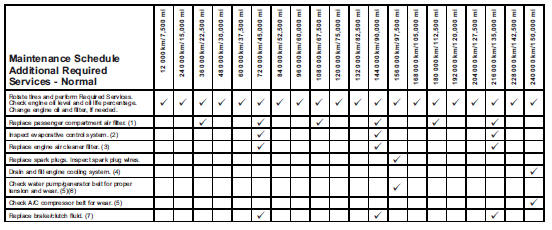
- Or every two years, whichever comes first. More frequent replacement may
be needed if the vehicle is driven in areas with heavy traffic, areas with poor
air quality, or areas with high dust levels.
Replacement may also be needed if there is a reduction in air flow, excessive window fogging, or odors.
- Check all fuel and vapor lines and hoses for proper hook-up, routing, and condition.
- Or every four years, whichever comes first.
- Or every five years, whichever comes first. See Cooling System on page 10-13.
- Inspect for fraying, excessive cracking, or damage.
- Inspect for fraying, excessive cracking, or damage. Check belt tension and replace if needed. See your dealer.
- Or every three years, whichever comes first.
Footnotes - Maintenance Schedule Additional Required Services - Severe
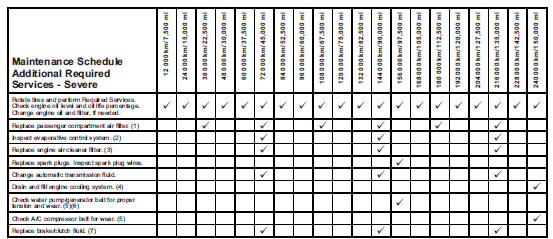
- Or every two years, whichever comes first. More frequent replacement may
be needed if the vehicle is driven in areas with heavy traffic, areas with poor
air quality, or areas with high dust levels.
Replacement may also be needed if there is a reduction in air flow, excessive window fogging, or odors.
- Check all fuel and vapor lines and hoses for proper hook-up, routing, and condition.
- Or every four years, whichever comes first.
- Or every five years, whichever comes first. See Cooling System on page 10-13.
- Inspect for fraying, excessive cracking, or damage.
- Inspect for fraying, excessive cracking, or damage. Check belt tension and replace if needed. See your dealer.
- Or every three years, whichever comes first.
 Engine Oil Change
When the %CHANGE DIC message displays,
have the engine oil and filter changed within the next 1 000 km/600 mi. If driven
under the best conditions, the engine oil life system may not indicate the ...
 Special Application Services
Severe Commercial Use Vehicles Only: Lubricate chassis components every
5 000 km/ 3,000 mi.
Have underbody flushing service performed. See "Underbody Maintenance" in
Exterior Care ...
Other materials:
Brake Assist
The Brake Assist feature is designed to assist the driver in stopping or decreasing
vehicle speed in emergency driving conditions. This feature uses the stability system
hydraulic brake control module to supplement the power brake system under conditions
where the driver has quickly and forcef ...
Manual Transmission
Caution
Shifting the vehicle initially into any gear other than 1 (First)
or R (Reverse) can damage the clutch. Shift the manual transmission in the proper
sequence, and time the gear shifting with the accelerator to avoid revving the engine
and damaging the clutch.
1 (First): Press the ...
Radio without Touchscreen
/VOL (Power/Volume)
Press to turn the system on and off.
Turn to adjust the volume.
Preset Buttons 1-6
Press and hold to store a station.
Press to go to a preset favorite station.
MENU/TUNE
Press to open menus and select menu items.
Turn to highlight menu i ...
