
Chevrolet Spark Owners Manual: Automatic Transmission
Continuously Variable Transmission (CVT)
The CVT is electronically controlled to produce maximum power and smooth operation. A display in the instrument cluster indicates the selected range.
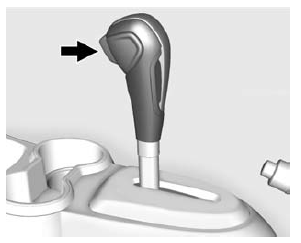
P (Park): This position locks the front wheels. Select P (Park) only when the vehicle is stationary and the parking brake is applied.
Warning
It is dangerous to get out of the vehicle if the shift lever is not fully in P (Park) with the parking brake firmly set. The vehicle can roll.
Do not leave the vehicle when the engine is running. If you have left the engine running, the vehicle can move suddenly. You or others could be injured. To be sure the vehicle will not move, even when you are on fairly level ground, always set the parking brake and move the shift lever to P (Park).
See Shifting Into Park on page 9-18.
Make sure the shift lever is fully in P (Park) before starting the engine.
The vehicle has a shift lock control.
The brake pedal must be fully applied, and the shift lever button pressed before shifting from P (Park) while the ignition key is in ON/RUN. If the transmission will not shift out of P (Park), ease pressure on the shift lever and push the shift lever all the way into P (Park) while maintaining brake application. Then move the shift lever into another gear. See Shifting out of Park on page 9-19.
R (Reverse): Use this gear to back up. Select R (Reverse) only when the vehicle is stationary.
Caution
Shifting to R (Reverse) while the vehicle is moving forward could damage the transmission. The repairs would not be covered by the vehicle warranty. Shift to R (Reverse) only after the vehicle is stopped.
To rock the vehicle back and forth to get out of snow, ice, or sand without damaging the transmission, see If the Vehicle Is Stuck on page 9-8.
N (Neutral): In this position, the engine does not connect with the wheels. To restart the engine when the vehicle is already moving, use N (Neutral) only. Also, use N (Neutral) when the vehicle is being towed.
Warning
Shifting into a drive gear while the engine is running at high speed is dangerous. Unless your foot is firmly on the brake pedal, the vehicle could move very rapidly.
You could lose control and hit people or objects. Do not shift into a drive gear while the engine is running at high speed.
Caution
Shifting out of P (Park) or N (Neutral) with the engine running at high speed may damage the transmission. The repairs would not be covered by the vehicle warranty. Be sure the engine is not running at high speed when shifting the vehicle.
D (Drive): This position is for normal driving. For faster acceleration, press the accelerator pedal all the way down and hold it there. The transmission shifts to a lower gear ratio depending on engine speed.
L (Low): This position reduces vehicle speed without using the brakes by using the braking effect of engine compression. It can help control vehicle speed going down steep hills, on long downhill grades, or on mountain roads, along with using the brakes off and on. This may prolong the life of the brake linings.
In the event of a fault, the malfunction indicator lamp illuminates. See your dealer for repairs.
 Engine Exhaust
Warning
Engine exhaust contains carbon monoxide (CO) which cannot be seen
or smelled. Exposure to CO can cause unconsciousness and even death.
Exhaust may enter the vehicle if:
The vehicle idl ...
 Manual Transmission
Caution
Shifting the vehicle initially into any gear other than 1 (First)
or R (Reverse) can damage the clutch. Shift the manual transmission in the proper
sequence, and time the gear shiftin ...
Other materials:
If a Tire Goes Flat
This vehicle has a tire sealant and compressor kit. See Tire Sealant and Compressor
Kit on page 10-56.
There is no spare tire, no tire changing equipment, and no place to store a tire.
It is unusual for a tire to blow out, especially if the tires are maintained
properly. See Tires on page 10-3 ...
Driving on Snow or Ice
Drive carefully when there is snow or ice between the tires and the road, creating
less traction or grip.
Wet ice can occur at about 0°C (32° F) when freezing rain begins to fall, resulting
in even less traction. Avoid driving on wet ice or in freezing rain until roads
can be treated with sal ...
Towing the Vehicle
Caution
Incorrectly towing a disabled vehicle may cause damage. The damage
would not be covered by the vehicle warranty.
Have the vehicle towed on a flatbed car carrier or a wheel lift tow truck.
If a wheel lift tow truck is used, the drive wheels cannot contact the road while
the vehicle is ...
